Loading...

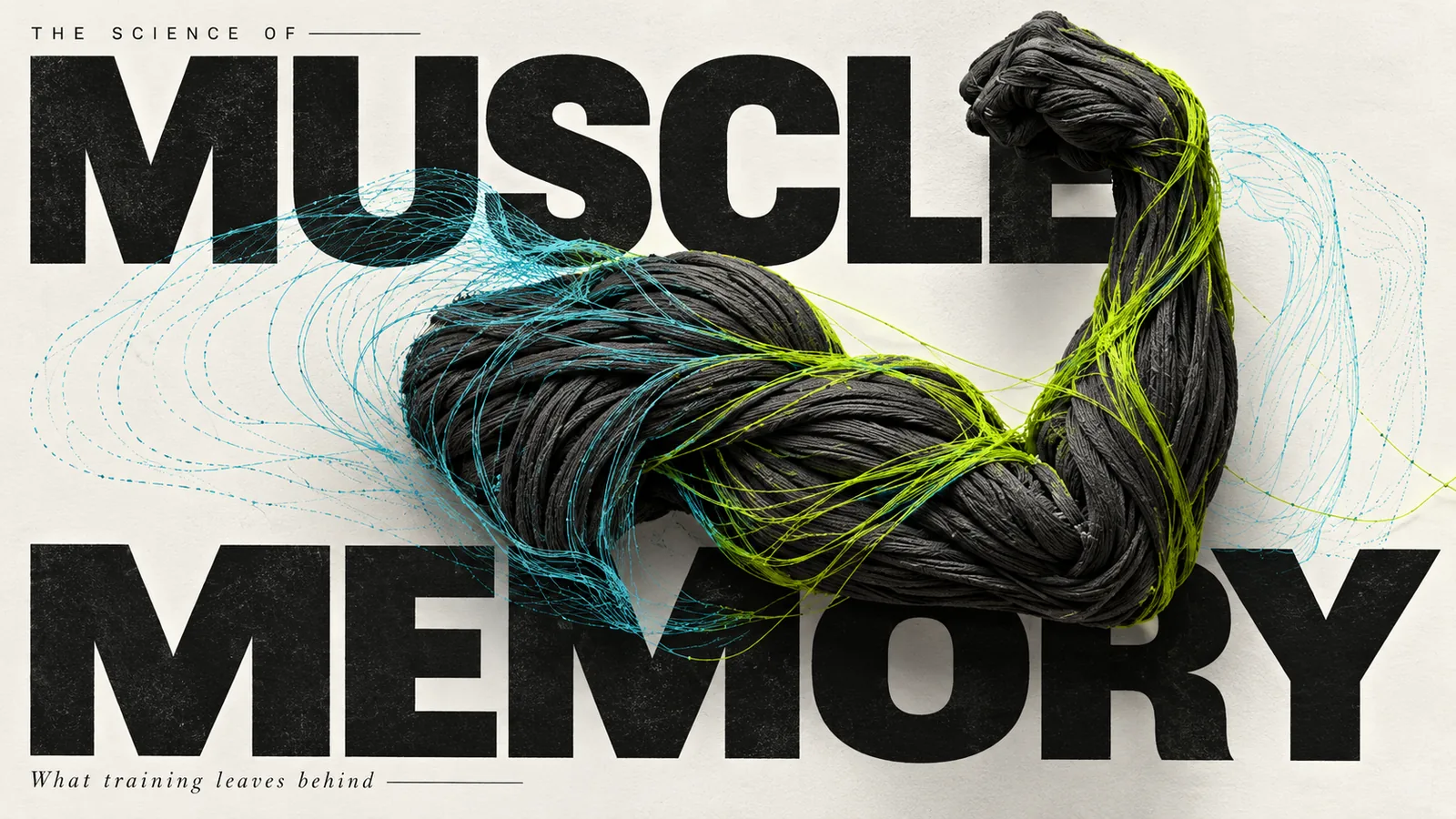
Muscle Memory: How Muscles May Remember Previous Growth
Regaining muscle after a training break can feel different from building it for the first time. This capacity to respond to previous training is commonly described as muscle memory.
One possible explanation involves changes retained inside muscle fibres, including their nuclei. However, the idea that these changes last forever—and always guarantee faster growth—is more certain than the evidence allows.
What Are Myonuclei?
Skeletal muscles contain long cells called muscle fibres. Unlike most cells, each fibre contains many nuclei, known as myonuclei.
These nuclei contain DNA and help regulate the production of proteins needed for muscle maintenance, repair and growth. Because a single muscle fibre can extend over a considerable distance, multiple nuclei help support its large structure.
How Do Satellite Cells Support Muscle Growth?
Mature muscle fibres generally gain additional nuclei through satellite cells, specialised muscle stem cells located alongside the fibres.
Satellite cells can become activated, multiply and fuse with muscle fibres, contributing new nuclei. Their involvement in repair and growth is supported by human research linking satellite-cell and myonuclear changes with training-induced hypertrophy.
This does not mean every small increase in muscle size requires an immediate increase in nuclei. The relationship is more flexible than a simple one-to-one rule.
What Is the Myonuclear Domain Hypothesis?
The myonuclear domain describes the amount of muscle-fibre cytoplasm associated with an individual nucleus.
The hypothesis proposes that each nucleus has a limited capacity to support its surrounding region. As a fibre grows, additional nuclei may help meet its increasing demands.
A human resistance-training study found that substantial fibre growth was associated with satellite-cell recruitment and additional myonuclei. This supports their importance in pronounced hypertrophy, without establishing an identical limit for every fibre or person.
Do Myonuclei Remain After Muscle Shrinks?
Some studies show that nuclei gained during growth remain when muscle fibres subsequently shrink. This observation underlies the idea of myonuclear permanence.
A 2024 study involving 12 participants examined strength training, detraining and retraining. Myonuclear numbers increased during the initial training period and remained elevated during 16 weeks of detraining, even as fibre size declined.
However, the retained nuclei did not produce a clearly superior growth response during retraining. The researchers therefore distinguished evidence of retention from proof of a functional advantage.
“Permanent” also needs careful interpretation. Retention over a study period does not establish lifelong retention under every circumstance.
Is Muscle Memory Only About Nuclei?
No. Changes in gene regulation may also contribute.
A 2018 human study on epigenetic memory examined muscle growth, detraining and renewed training. Researchers identified DNA methylation patterns consistent with a lasting molecular response to previous growth.
These chemical marks influence gene regulation without changing the underlying DNA sequence. The findings suggest that muscle memory may involve several biological processes rather than one permanent structural change.
How Do Anabolic Steroids Fit Into the Research?
A frequently cited 2013 mouse study investigated whether previous testosterone exposure could leave a lasting cellular effect.
After exposure ended and muscle size returned towards its earlier level, myonuclear numbers remained elevated. The previously exposed muscles later showed greater growth in response to overload.
This supports a possible mechanism for persistent effects after steroid exposure in mice. It does not establish the size or duration of an equivalent advantage in humans, nor does it demonstrate that steroid use is safe.
What Does This Mean for Retraining?
Previous training can leave measurable changes even after muscle size decreases. That is an encouraging finding, but research cannot provide a universal timetable for regaining lost muscle.
The strongest interpretation is that muscles can retain aspects of their training history. How much those retained changes accelerate future growth—and how long they persist—remains an active research question.
No members are reading this right now
Nobody has answered this yet.
If you have run it, what happened to you is the answer. What you took and for how long, what changed, and your bloodwork if you have it.
You do not need to be an expert. You need to have taken it.